
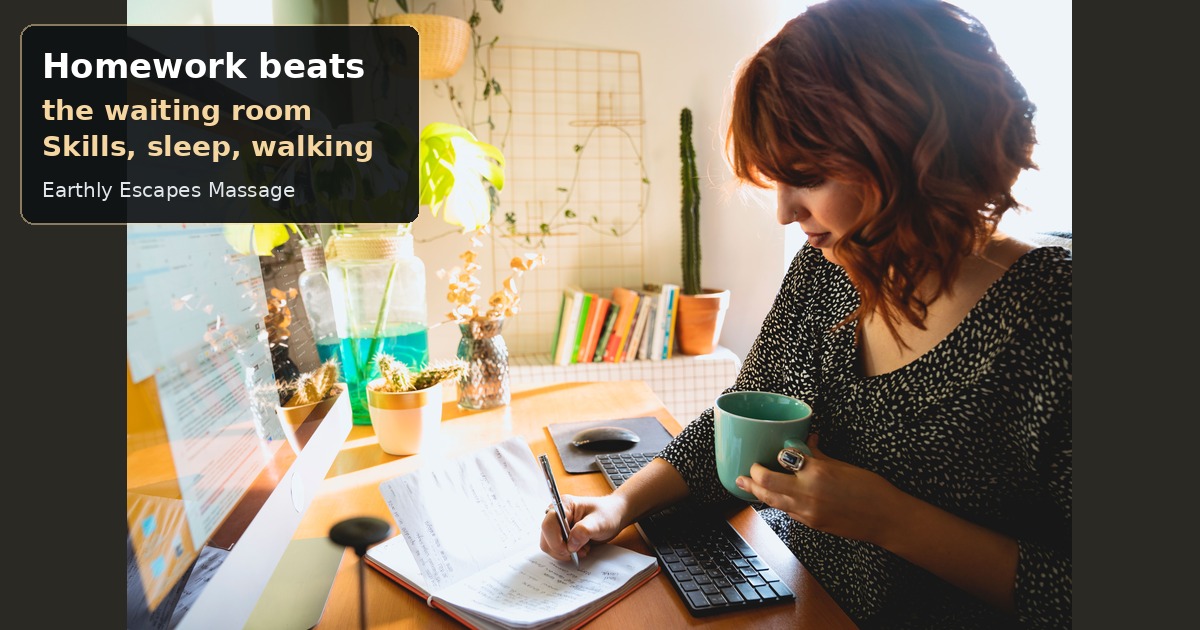
Here's something interesting that I came across: a big Yale-led study of veterans with chronic pain found that a self-directed version of cognitive behavioral therapy, the kind you do at home with skills practice, sleep habits and a walking program, cut how much pain got in the way of daily life more than the usual clinician-delivered version. And those gains held for up to a year.
I hear a lot about waiting. Waiting for a specialist. Waiting for the next appointment. Waiting for a day when pain feels quieter. This research doesn't erase the need for good medical care, and it doesn't put massage in the driver's seat. What that points to is that the "homework" of self-care can be powerful, sometimes even more so than sitting in another waiting room.
The study, published in JAMA and covered by Yale School of Medicine and VA Research, enrolled 764 veterans with chronic musculoskeletal pain across nine VA health systems. Half were assigned to COPES, short for Cooperative Pain Education and Self-management. That's an 11-week, phone-based program with a handbook of pain skills, a gradual walking plan, short daily check-ins and a weekly personalized voice message from a coach. The other half received clinician-delivered CBT for chronic pain under usual practice conditions, typically four to 11 weekly sessions.
At four months, the self-directed group reported less pain interference on a 0-to-10 scale, with mean scores of 5.26 versus 6.23. The difference was statistically clear but small, near what researchers call clinically meaningful. The advantage held at six and 12 months. COPES participants also started sooner, a median of 16 days versus 41, completed more of their expected sessions, and showed better results on sleep, depression and other secondary outcomes. First author Alicia Heapy, PhD, of Yale and VA Connecticut, put the pattern plainly: "The pattern was very clear—at each time point across almost all outcomes, the self-directed treatment was better."
That doesn't mean clinician-delivered therapy stopped working. Both groups improved, and Heapy has said the system needs both options. Some people prefer one-on-one care or have more complex needs. The honest takeaway is that a well-designed home program, with real coaching and daily practice, can be a strong alternative when access, travel or scheduling get in the way.
Why am I talking about this as a massage therapist in Palestine? Because it lines up with what I see every week. The people who feel better over time are usually the ones doing something between visits. Stretching. Walking. Sleeping a little more carefully. Paying attention to what flares them up. Massage can be one warm, hands-on piece of that picture. It isn't a substitute for CBT, for a doctor's care or for the skills a program like COPES teaches.
I'll keep the claims modest, because the science asks me to. The National Center for Complementary and Integrative Health notes that cognitive behavioral therapy is the prevailing psychological intervention for chronic pain, and that it can help decrease pain intensity and improve physical functioning. On massage, NCCIH's summary is careful: evidence for low-back pain is weak, massage may help neck pain but benefits may be short-lived, and guidelines don't treat massage as a cure. So when someone comes in after a weekend of walking goals and sleep practice, I'm not trying to replace their homework. I'm trying to support the body that's doing it. A foot massage after a week of new walking goals, or hot stones on a back that's been holding tension while you practice better sleep, can feel like a kindness that helps you keep going.
If you're living with pain that hangs around, start with your clinician. Ask whether a self-management or CBT program makes sense for you. VA members can ask about COPES where it's available. For everyone else, a trusted provider can help you find skills-based options that fit your life. And if a massage sounds like a useful complement while you practice those skills, I'm here.
My 60-minute massage is $80 and includes hot stones and aromatherapy. First-time clients get 10% off their first visit. I'm in my room inside the salon in Palestine on Tuesdays and Wednesdays from 9 AM to 6 PM, and starting Nov. 28 I'll also be open Saturdays from 9 AM to 2 PM. You can book online here.
Three small things you can try this week, with your doctor's okay: take one short walk most days, even if it's just around the block; pick one wind-down habit for better sleep, like dimming screens an hour before bed; and notice one thing that makes your pain better or worse, then write it down. Homework doesn't have to be fancy to count. It just has to be yours.
— EarthlyEscapesMassage
Photo by Los Muertos Crew on Pexels.